

This publishing platform brings together essays, lectures, reflections, and research by Vangeline exploring Butoh through the lenses of dance, embodiment, history, pedagogy, feminism, the nervous system, and contemporary culture. These writings emerge from more than three decades of artistic practice, choreography, teaching, and ongoing dialogue with Butoh communities around the world.
The first publication in this series, Butoh, Sensitivity, Sensuality, and the Nervous System, is accompanied by a lecture of the same title. Drawing from both artistic practice and contemporary understandings of the nervous system, Vangeline proposes a new framework for understanding Butoh through bodily sensitivity, perception, and regulation. The essay also reexamines the historical contributions of women to the development of the art form and explores receptivity as both a technical skill and an aesthetic principle within Butoh.
Through these writings, Vangeline develops an evolving body of research connecting Butoh, perception, embodiment, and contemporary culture. Ultimately, she proposes Butoh as a practice of integration, presence, and profound connection—to oneself, to others, and to the larger living systems of which we are a part.
BUTOH, SENSITIVITY, SENSUALITY, AND THE NERVOUS SYSTEM
by Vangeline
Butoh is often described as the dance of darkness. Yet this description, while evocative, rarely explains what occurs physiologically and perceptually inside the body of a Butoh dancer. The imagery does not fully explain why and how Butoh fundamentally differs from many other forms of dance. To foster a new understanding of Butoh, I propose approaching the art form through the perspective of the nervous system and bodily sensitivity.
The first step into Butoh is a practice of redirecting our attention to the life of the body. In contemporary life, our attention is constantly pulled outward—toward screens, productivity, social performance, stimulation, and/or anticipation of the future. Modern life conditions our minds toward both acceleration and fragmentation. As a result, we are becoming increasingly disconnected from internal sensations, from the subtle signals of our bodies, and cut off from the continuous flow of information emerging from within ourselves.
It is highly possible that our adaptive skills lag behind the current pace of technological advances and that these new, modern forms of multitasking we are subjected to cause overwhelm and stress to our nervous systems.
In the face of these relatively new human challenges, Butoh proposes another orientation. Rather than turning outward, it asks us to radically turn toward our interior experience– through the body. Simply put, Butoh asks us to inhabit the present moment through sensation.
This return to the body is not merely aesthetic: it reorganizes our perception.
In most adult experiences, information is processed cognitively first. Thoughts dominate sensation; logic organizes emotion, and the life of the body becomes secondary. Neuroscience often refers to this as “top-down processing”: the cognitive mind regulates and filters experience before it fully reaches conscious awareness. We live largely inside the prefrontal cortex—the region associated with planning, inhibition, judgment, self-monitoring, and social regulation.
Butoh reverses this hierarchy.
Instead of beginning with thought, Butoh begins with sensation. Attention is redirected toward sensori-motor awareness: weight, temperature, muscular tone, texture, breath, internal impulses, vibration, gravity, tension, trembling, softness, pain, pleasure, memory. From this perspective, movement does not originate primarily from choreography imposed onto the body, but from listening and paying close attention to processes already occurring inside the organism.
In this sense, Butoh functions through what might be described as a form of “bottom-up processing.” Sensation precedes interpretation, and our body becomes a site of discovery.
This reversal is essential. Butoh dancers are deeply curious about layers of experience that often remain inaccessible: unconscious impulses, bodily memory, emotional residues, instinctive reactions, and preverbal states. They learn to perceive not only voluntary movement, but involuntary movement—the subtle reactions, reflexes, and energetic shifts constantly fluctuating beneath conscious awareness.
Traditional dance forms frequently prioritize intentionality: the dancer decides to move and then executes movement. Butoh, by contrast, is equally interested in what appears before conscious decision. A tremor, a collapse, a recoil, a hesitation, a change in breath, a reflexive contraction—these are not considered interruptions to the dance. They become material for the dance itself.
This distinction radically transforms the relationship between performer and body. The body is no longer treated as a disciplined object to dominate or perfect. Instead, it becomes a field of perception, and a never-ending source of material.
For this reason, sensitivity occupies a central role in Butoh training. Sensitivity is not understood as emotional fragility, but as heightened perceptual capacity —a capacity that must be trained.
This capacity is the ability to receive information from both inside and outside the body simultaneously. The skin, for example, becomes more than a physical boundary separating self from world. It becomes an organ of communication, constantly exchanging information through pressure, temperature, vibration, contact, atmosphere, and spatial relation.
One of my teachers, Mari Osanai, often described the skin as a “second brain.” This idea is particularly meaningful in Butoh. As attention turns toward sensations arising from the skin, muscles, breath, and nervous system, the cognitive filters that normally organize perception begin to soften. As a result, many practitioners experience a corresponding expansion of perception that can feel ecstatic, overwhelming, destabilizing, and profoundly alive.
This heightened sensitivity is intimately connected to the autonomic nervous system.
The autonomic nervous system regulates two major physiological states: activation and relaxation. The sympathetic nervous system is associated with arousal, stress, vigilance, excitement, fight-or-flight responses, and survival mobilization. The parasympathetic nervous system, by contrast, is associated with rest, recovery, safety, digestion, restoration, and relaxation.
In our modern life, humans tend to be trapped in a chronic state of sympathetic activation. Constant stimulation, speed, anxiety, digital overload, social pressure, economic instability, and continuous productivity demands generate bodies that struggle to return to a state of rest.
Ironically, although Butoh has often been perceived as a disruptive art form, many of its foundational techniques cultivate parasympathetic regulation before focusing on instability.
Although profoundly memorable and striking, instability is merely the tip of the iceberg. In order to play with instability as a craft, we need to first learn to connect authentically to the very conditions that can either generate or regulate said instability.
More importantly, we need to cultivate its opposite: stability and neutrality. These regulation skills come directly from getting to know our own nervous system.
Following the image of an iceberg, the submerged part is the parasympathetic nervous system. Practices such as Noguchi Taiso—which profoundly influenced the development of Butoh in postwar Japan—emphasize release, heaviness, fluidity, softness, suspension, and reduced muscular resistance. Rather than imposing form through force, the dancer learns to surrender unnecessary tension and allow movement to emerge through gravity, momentum, and internal responsiveness.
Relaxation in Butoh is not passivity. It is receptivity.
This distinction is crucial.
Within highly relaxed states, the performer often becomes more sensitive, not less. Reduced muscular tension allows subtle impulses, sensations, and emotional states to become perceptible. The dancer becomes increasingly capable of receiving information from the body without immediately suppressing, categorizing, or controlling it. More importantly, Butoh dancers can organize this information into a dance.
Many of the central aesthetic qualities associated with Butoh—slowness, fluidity, states of suspension; or conversely, metamorphosis, instability, and dissolution of identity—emerge directly from this altered relationship to tension and nervous-system regulation.
At an advanced level of practice, Butoh does not remain exclusively in constant relaxation. The dancer learns to move fluidly between activation and surrender, intensity and neutrality, sympathetic charge and parasympathetic grounding. Sudden eruptions of force, trembling, violence, erotic charge, animality, or emotional intensity may arise rapidly, but the performer must also develop the capacity to return to stillness and regulation without becoming trapped inside activation.
In this sense, Butoh is not simply expressive. It trains modulation.
The emergence of receptivity as a key technique helps illuminate the historical role women played in the development of the art form.
Although Butoh history has traditionally centered male founders such as Tatsumi Hijikata and Kazuo Ohno, many of the form’s most important technical and aesthetic developments emerged through the bodies and labor of women.
Between the late 1960s and mid-1970s, Hijikata worked extensively with female dancers such as Yoko Ashikawa and Natsu Nakajima. Ashikawa, in particular, became central to the development of Butoh notation and choreographic experimentation.
While Hijikata often functioned as director and conceptual architect, movement material frequently emerged through the improvisational capacities and depth of surrender of the women working with him. Through these dancers, receptivity evolved into a highly refined, technical practice.
And it is my contention that women—one woman in particular, Yoko Ashikawa—not only brought receptivity into the art form, but that, thanks to her, receptivity itself became a form of virtuosity in Butoh. Perhaps this remains one of Butoh's best-kept secrets.
Since the bodies of women were not merely interpreting Butoh; they were generating it, the history of these collaborations complicates the accepted versions of authorship in Butoh’s history.
Further, many of these dancers financially supported the Butoh community through cabaret performance, erotic dance, striptease, and nightclub labor. These experiences are rarely centered within official histories of Butoh, yet they may have profoundly shaped the trajectory of the art form.
This connection between erotic labor and Butoh is often misunderstood. To acknowledge it is not to reduce Butoh to a sexualized art form. Rather, it reveals that sensuality, receptivity, seduction, energetic modulation, and bodily responsiveness were cultivated through lived physical practices that deeply informed the evolution of Butoh aesthetics.
Sensuality in Butoh extends far beyond sexuality alone. It is linked to receptivity itself: the capacity to feel deeply, to receive sensation fully, and to remain permeable to experience. Through deeper states of relaxation and receptivity, the body becomes increasingly capable of accessing states of vulnerability, pleasure, grief, instinct, memory, ecstasy, and transformation.
In Western culture, sensuality is frequently reduced to visual consumption and sexual performance. Butoh offers another possibility. Sensuality becomes an expanded state of embodiment—a heightened intimacy with sensation, aliveness, and interconnectedness.
It was actually through my own experience as a performer that many of these principles and correspondences became fully legible to me.
Before dedicating myself fully to Butoh, I worked extensively in burlesque, cabaret, and striptease performance in New York City while simultaneously training in dance. At the time, I did not yet understand how profoundly these experiences would shape my artistic development. Working within erotic performance required not only stamina and theatricality, but also technical knowledge: how to manipulate energy, attention, rhythm, presence, seduction, tension, release, and audience perception repeatedly and under pressure.
These were not abstract concepts. They were embodied techniques.
Yet forms of knowledge associated with femininity, sensuality, erotic labor, and the sexualized body are often dismissed or stigmatized within dominant cultural structures. The contributions of women become marginalized precisely because they emerge through territories society associates with shame, desire, pleasure, or eroticism.
Therefore, reclaiming these histories becomes important artistically and politically. It does more than restore visibility to women in Butoh: it may also change our understanding of how the art form itself evolved and developed.
Discussions of women in Butoh have often followed a dominant narrative: that the art form itself was primarily created by two male founders. More recently, it has become evident that many women’s contributions were obscured within the art form. Both versions are true, depending on our definition of authorship.
However, this may not simply be a question of women’s contributions being overlooked within Butoh’s history. Although it is vital to restore women’s rightful contributions, there may be room for a more nuanced perspective.
It is very possible that the very gendered dynamics through which Butoh developed helped cultivate the specific modes of receptivity, surrender, and perceptual responsiveness that eventually became central technical and aesthetic principles within the art form itself.
In fact, Butoh may be understood as an art form shaped through the encounter between gendered bodies operating within asymmetrical relational structures. It is possible that this encounter, perhaps more than the often-cited dialogue between Japan and the West, gave rise to an entirely new technical and aesthetic language.
Thanks to these innovative techniques, Butoh ultimately offers a space where fragmentation may begin to dissolve. Instinct, sensation, cognition, imagination, memory, and emotion no longer function as isolated compartments. They are not merely experienced as reactive and disorganized states. Through heightened sensitivity and nervous-system awareness, the performer enters a more integrated, regulated relationship with the body and the nervous system. This is no longer a series of “states,” but a deeply creative process, organizing chaos into a dance.
In Butoh, the body is a threshold toward more deeply integrated forms of consciousness. Perhaps this is why Butoh can produce experiences often described as ecstatic. Through sensation, receptivity, and presence, the performer may experience a profound continuity between interior and exterior worlds—a temporary dissolution of separation. Through Butoh, we experience ourselves as a living ecosystem, part of a much larger ecosystem.
In this sense, Butoh is not simply a dance form. Butoh is a tool for decentering and connection.
Bypassing limitations of the intellect, it is a bridge, through the body, into integration and expanded consciousness.
© Vangeline, 2026.
May 29, 2026
Vangeline. “Butoh, Sensitivity, Sensuality, and the Nervous System.” New York Butoh Institute, 2026. https://www.vangeline.com/writings/2026/5/28/butoh-sensitivity-sensuality-and-the-nervous-system-by-vangeline
WATCH THE COMPANION LECTURE
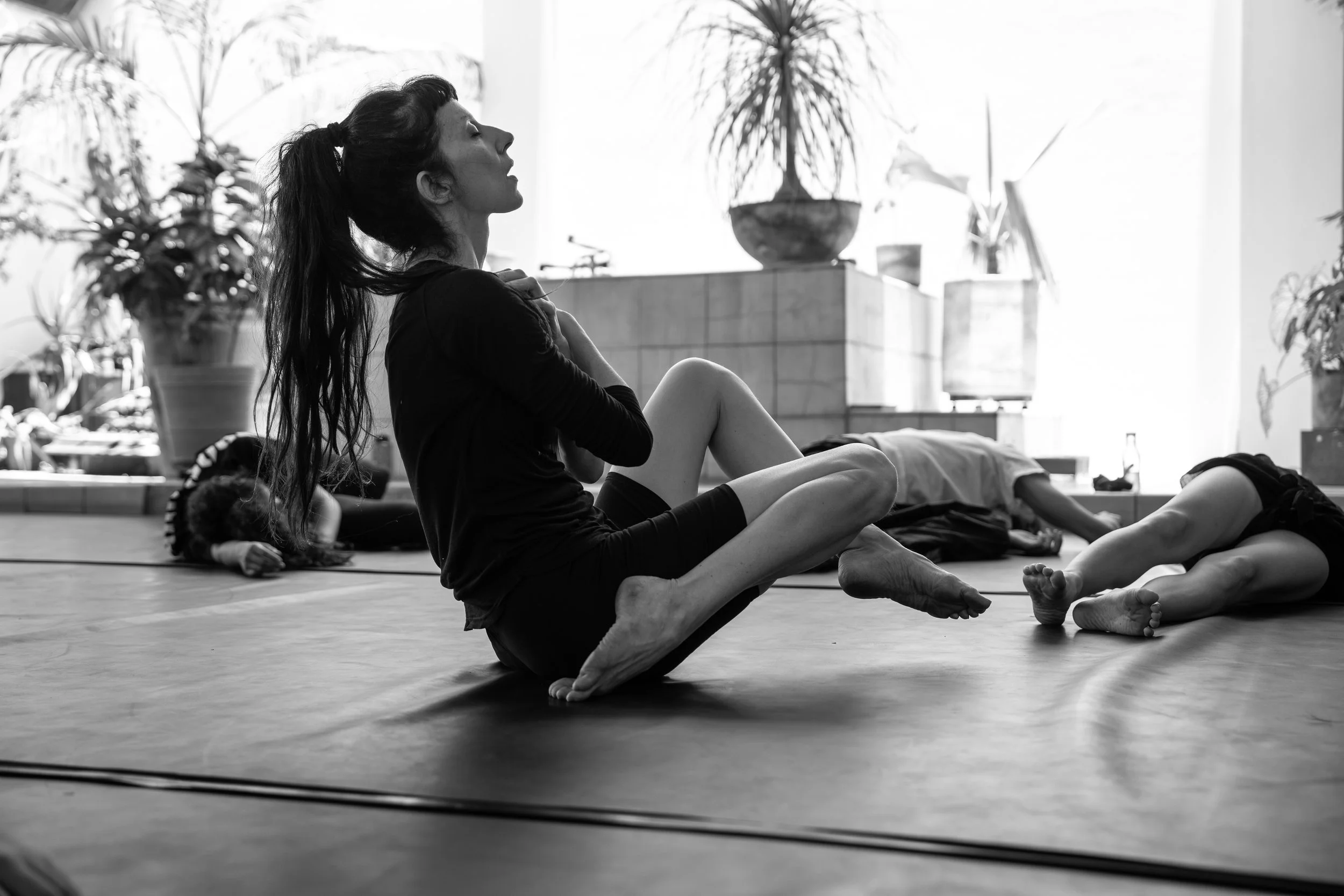
Vangeline teaching in Guadalajara, Mexico. Photos by Brenda Molgado.
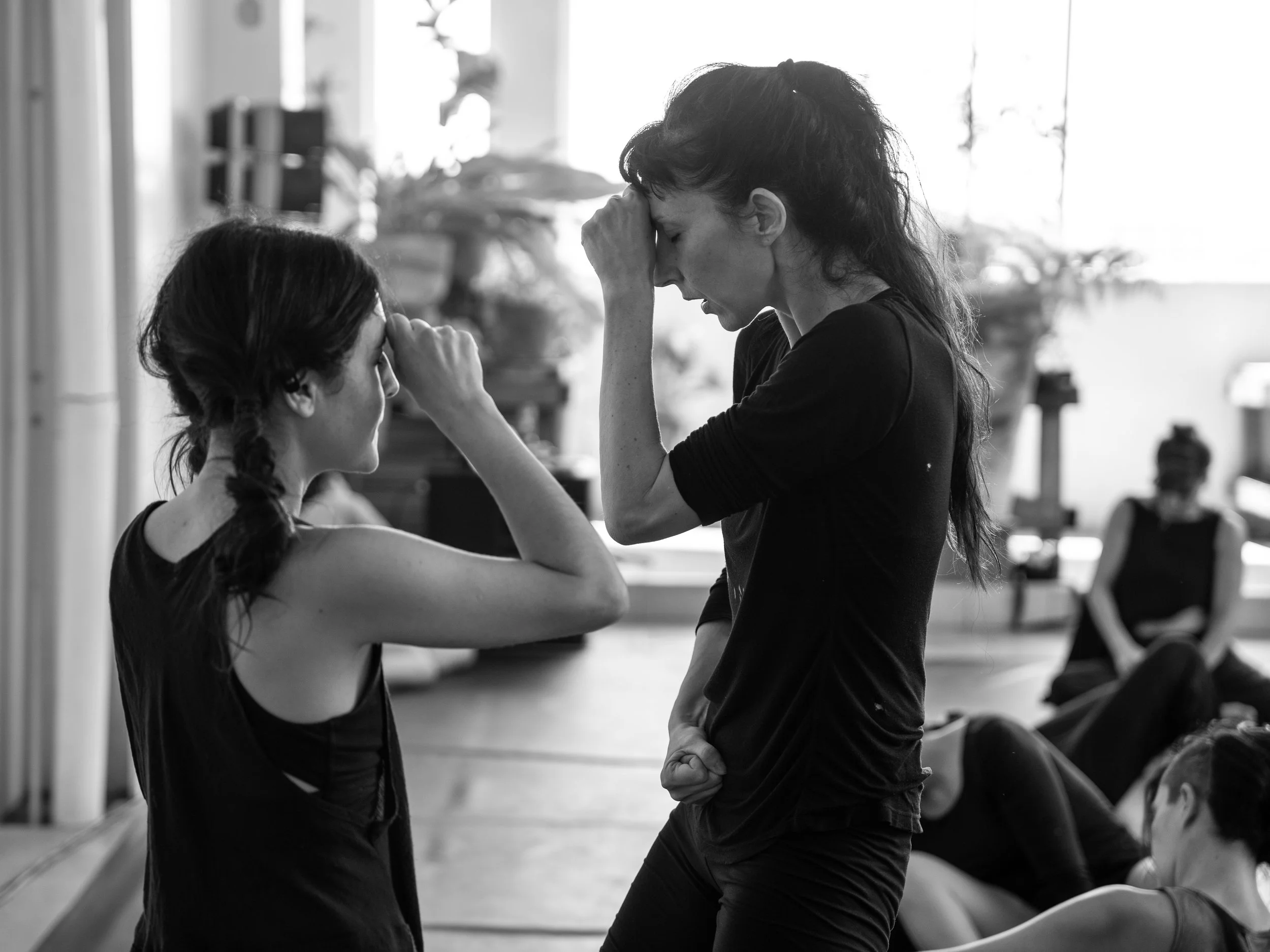
Butoh teacher Vangeline and a workshop participant face one another during an exercise, each with a hand resting on the forehead, in a bright dance studio.
Vangeline seated on the studio floor during a Butoh workshop, eyes closed and body lifted in a poised, attentive position while participants rest and observe nearby.
The Spanish edition of Butoh, Sensitivity, Sensuality, and the Nervous System was made possible through the work of two extraordinary collaborators from Mexico:
Adriana Elizondo — Translator, Butoh artist, and editorial collaborator.
Teresa Barajas — Graphic designer and visual collaborator.
My deepest thanks for their creativity, sensitivity, and commitment to this multilingual project.