
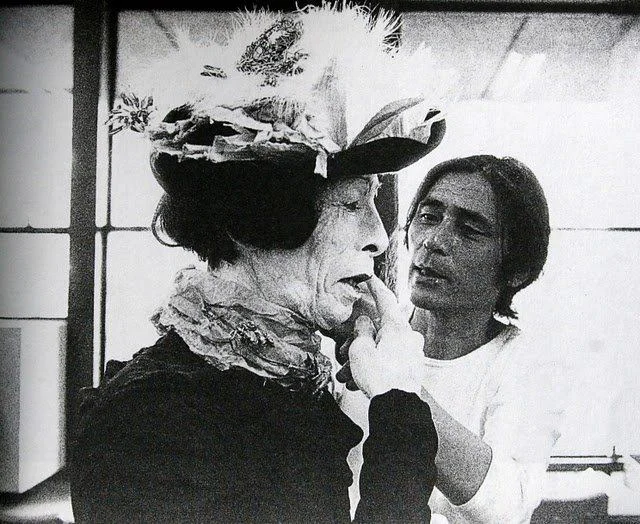
ABOUT BUTOH
Butoh is a Japanese dance and performance practice that emerged in postwar Japan through the work of Tatsumi Hijikata, Kazuo Ohno, and their collaborators. Since its emergence in the late 1950s and early 1960s, Butoh has evolved into a diverse international art form practiced throughout Asia, Europe, the Americas, and beyond.
Although often associated with white body makeup, extreme slowness, or surreal imagery, Butoh is not defined by a particular aesthetic. Rather, it is a practice centered on perception, sensation, and embodiment.
At its core, Butoh trains the capacity to listen to the body.
Through attention to gravity, sensation, imagery, memory, the environment, and movement, performers cultivate an increased sensitivity to internal and external experience. Rather than imposing movement from the outside, Butoh encourages dancers to discover movement through a heightened relationship to the body and its sensations.
Practitioners learn to navigate a wide range of physical, emotional, and imaginative states while maintaining awareness and agency. Stillness and movement, effort and surrender, intensity and neutrality all become part of a continuous process of exploration.
Historically, Butoh developed through a rich dialogue between choreography and improvisation, Japanese and international influences, and the contributions of numerous artists. While Tatsumi Hijikata and Kazuo Ohno are widely recognized as its principal founders, many of Butoh's most important technical and aesthetic developments emerged through collaborations with dancers such as Yoko Ashikawa, Natsu Nakajima, and Saga Kobayashi.
By the late 1960s, Butoh had begun to develop along two distinct paths. Under Tatsumi Hijikata's direction, one branch became increasingly choreographed and notation-based. Another branch, represented by artists such as Kazuo Ohno and Akira Kasai, emphasized improvisation, personal exploration, and spontaneous composition. This improvisational approach was influenced by modern dance traditions, particularly German Ausdruckstanz (Neue Tanz), as well as by Japanese movement disciplines such as Aikido. The dynamic exchange between these approaches continues to shape Butoh practice today.
Today, Butoh encompasses a wide spectrum of approaches, ranging from highly choreographed works to improvisational and interdisciplinary practices. What unites these diverse expressions is a commitment to embodied inquiry and a willingness to engage deeply with sensation, perception, and the unknown.
The word "Butoh" derives from Ankoku Butoh, often translated as "Dance of Utter Darkness." For Tatsumi Hijikata, darkness did not refer to evil or negativity, but rather to aspects of human experience that remain hidden from ordinary awareness. In this sense, Butoh invites us to explore dimensions of ourselves that lie beyond habit, convention, and ordinary patterns of perception.
Author: Vangeline. June 1, 2026.
Further Reading
WRITINGS — From History to Theory
A multilingual publishing platform featuring essays, lectures, reflections, and research on Butoh, dance, embodiment, feminism, pedagogy, and contemporary culture.

IN ESPAGNOL: https://www.vangeline.com/escritos
Durante los próximos meses y años, este nuevo proyecto editorial será un espacio dedicado a ensayos, conferencias, reflexiones e investigaciones que exploran el Butoh desde las perspectivas de la danza, la corporalidad, la historia, la pedagogía, el feminismo, el sistema nervioso y la cultura contemporánea. Muchos de estos escritos surgen de décadas de práctica artística, enseñanza, coreografía y diálogo con comunidades de Butoh alrededor del mundo.
EN FRANCAIS: https://www.vangeline.com/ecrits
DÉCOUVREZ ÉCRITS— De l'Histoire à la Théorie
Une Nouvelle Plateforme Multilingue sur le Butoh — Lire le Premier Article
Au cours des prochains mois et des prochaines années, ce nouveau projet éditorial deviendra un espace consacré à des essais, conférences, réflexions et recherches explorant le Butoh à travers les prismes de la danse, du corps vécu, de l'histoire, de la pédagogie, du féminisme, du système nerveux et de la culture contemporaine. Nombre de ces textes sont issus de plusieurs décennies de pratique artistique, d'enseignement, de création chorégraphique et de dialogue avec les communautés du Butoh à travers le monde.
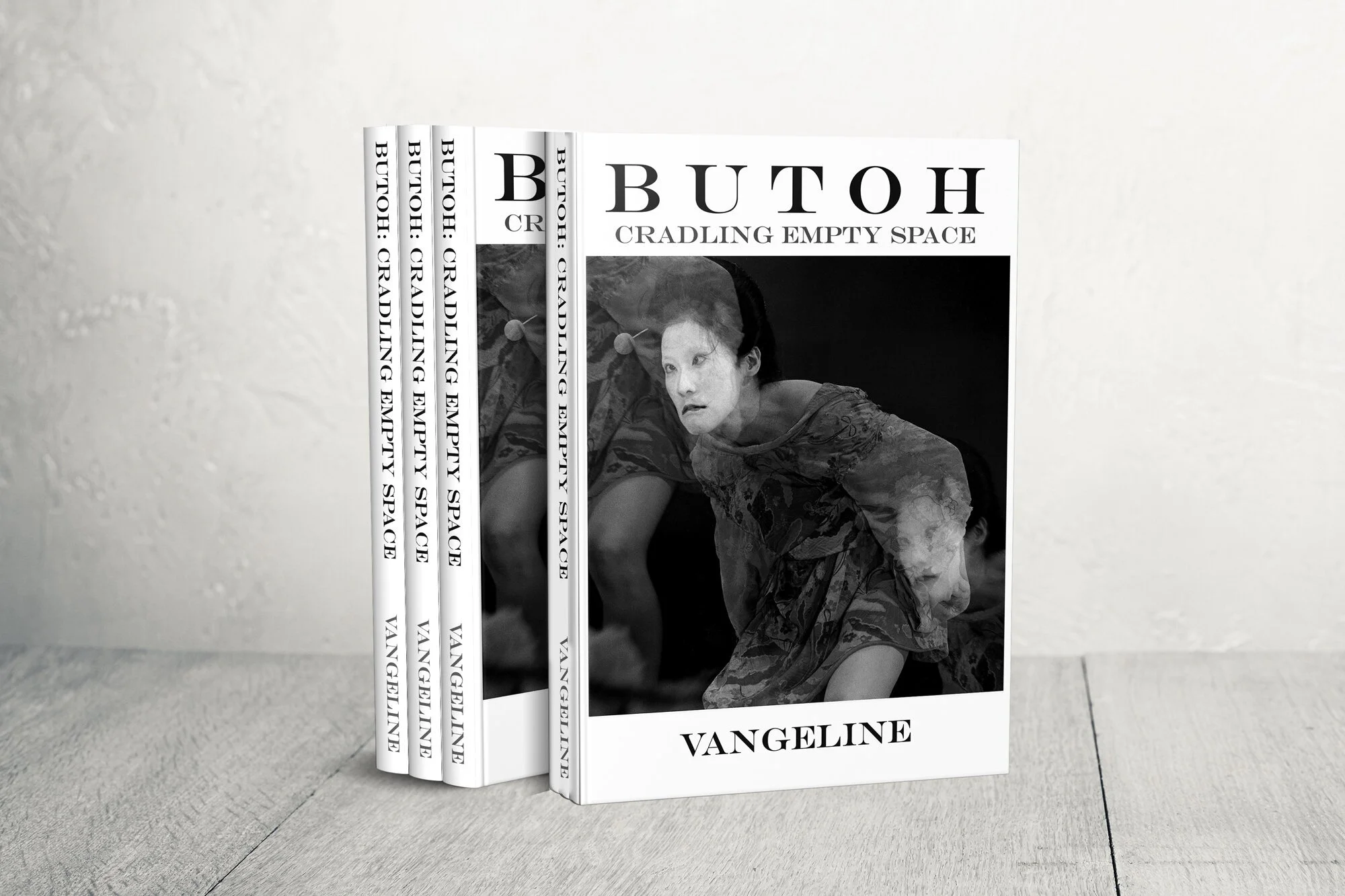
BUTOH: CRADLING EMPTY SPACE
A practical introduction to Butoh by Vangeline.
PURCHASE BUTOH: CRADLING EMPTY SPACE
Approaching the avant-garde Japanese performance art form of butoh from a cross-cultural, gender studies, and scientific perspective, award-winning artist and teacher Vangeline brings a fresh look at this postmodern dance form.
Butoh, a performance art form that grew out of the Japanese avant-garde scene of the 1950s, has traveled from east to west over the last 60 years, growing in popularity as it evolves. With origins in modern dance, French mime, and the surrealist movement, this fascinating postmodern dance genre is often thought of as mysterious and is frequently misunderstood. Through twenty years of research, interviews with some of the world’s top practitioners, historical documents, and rare photographs, Vangeline shines a light on this “dance of darkness.”
New revelations include the under-represented role of women in the development of the form, the connection between butoh and neuroscience, and the cross-cultural perspective of international influences on the evolution of the dance. Butoh: Cradling Empty Space will appeal to dance students, teachers, performance art scholars, movers, and anyone interested in choreography, theater, and Japanese history, culture, and art.
The book includes rare photographs, helpful graphics, a detailed bibliography and footnotes, and resources for additional information.
https://www.vangeline.com/butoh-book
Banner image: Hiroaki Tsukamoto. All rights reserved.
Video: Yoko Ashikawa
QUOTES
“I would love to offer you even something as tiny as a grain of sand. If only I could succeed in doing that, then I might fulfill my longing to share a part of my life with you. Isn’t it worth risking one’s life to offer something as microscopic as that tiny single grain of sand chosen from amidst countless millions? Take great care at all times. Even the most infinitesimal detail of the slightest gesture you make should be executed with loving care.
It’s never too late to start”.
-Kazuo Ohno, from Kazuo Ohno’s World: From Without & Within
“A great many people are constantly coming to life in me. Aren’t they reaching out to me in my day-to-day life as their souls permeate my body? That’s not inconceivable. Since each and everyone of us is born in and of this universe, we’re linked to every single thing in it. There’s nothing to stop us from reaching out and touching the entire universe”.
-Kazuo Ohno, from Kazuo Ohno’s World: From Without & Within
“And now, I live in a world where I strum this wooden floor beneath my feet. I live in a world where there are no boundaries between here and the hereafter”.
-Kazuo Ohno, from Kazuo Ohno’s World: From Without & Within
TATSUMI HIJIKATA
"Since the Body itself perishes, it has a form. Butoh has another dimension".
"The Body is constantly violated by things like the development of technology”.
"Underground art turns into mere trendiness because of the people practicing it. They create a desert around them, then complain there is no water, Why don't they try drinking from the well of their own bodies? Let them pluck the darkness from their own flesh."
-Tatsumi Hijikata